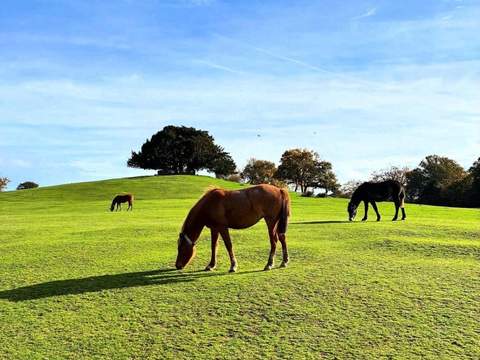
New Forest National Park
 England · Europe · Visited 15 November 2025 · Established 2005
The New Forest is the national park I know best. It's about an hour from home, and I've lost count of how many times I've visited. That familiarity could easily breed indifference, but it hasn't. Every time I go back, I find something new, or at the very least have a pony blocking the road at a different junction.
The park dates back to 1079, when William the Conqueror designated it as a royal hunting ground. That protection, nearly a thousand years of it, is a large part of why the landscape survives as it does today. It's one of the largest remaining tracts of unenclosed pasture land, heathland, and ancient woodland in western Europe, and the whole park is a Site of Special Scientific Interest. It may be one of the UK's smallest national parks, but what it packs into its 566 square kilometres is remarkable.
What makes it work
The New Forest is brilliant for both families and solo visitors because it doesn't ask you to choose one thing. You can spend a morning walking through ancient woodland, camp in one of the many campsites, grab lunch in one of the many villages dotted around the park (Brockenhurst, Burley, Lyndhurst, and others all have excellent pubs and cafés), then head south to the coast for an afternoon on the beach. I once ran a marathon here with no training, four hours of slogging through forest trails, questioning every life decision that had led to that moment. The New Forest is a beautiful place to run. It is a terrible place to discover you haven't done enough long runs.
Beaulieu is a must for car enthusiasts, home to the National Motor Museum and its collection of over 250 vehicles. The Isle of Wight ferry departs from Lymington on the park's southern edge, making the New Forest a natural gateway to the island.
And then there are the animals. The New Forest's free-roaming ponies, cattle, donkeys, and pigs are the "architects of the Forest" — their grazing shapes the landscape and maintains the mosaic of habitats that makes the park so ecologically important. You will encounter them on the roads. I've been stuck in pony jams, cow jams, and pig jams on more visits than I can count. They have right of way, and they know it.
The wildlife
Beyond the commoners' animals, the New Forest is recognised as an international biodiversity hotspot. It's home to all six of Britain's native reptile species, including the rare smooth snake and the incredibly scarce sand lizard, which survives here thanks to a successful breeding and release programme. The heathlands support rare ground-nesting birds like the nightjar, woodlark, and Dartford warbler, and the ancient woodlands hold goshawk, all three native woodpecker species, and a recently discovered pine marten population. In total, an estimated 860 species were recorded across just ten survey sites in a recent conservation project, representing only around five per cent of the park's total biodiversity.
Who it's for
The New Forest is one of the most accessible and versatile national parks in the UK. It doesn't have the dramatic peaks of the Lake District or the remoteness of the Scottish Highlands, but it doesn't need them. What it offers instead is variety, ease, and a depth of natural and cultural history that rewards repeated visits. Whether you're after a quiet walk through ancient trees, a day at the beach, a cream tea in a thatched village, or a traffic jam caused by a pig, it delivers. It's the national park you keep coming back to, and it never disappoints.